


Python基础:if与while语句详解及实战应用

本文深入解析Python中的if语句与while循环。详细讲解if语句的条件测试、大小写敏感性及and/or多条件判断;介绍while循环的基本用法、标志位控制、break与continue语句,以及利用while循环处理列表和字典的实际案例,帮助初学者掌握程序流程控制核心。
一、if语句
if语句允许程序检查当前状态并据此执行相应操作。它常用于处理列表,以便对特定值或大多数元素进行差异化处理。
1、简单示例
names=['xiaozhan','caiyilin','zhoushen','DAOlang','huangxiaoming']
for name in names:
    if name == 'caiyilin':   #注意:双等号'=='解读为“变量name的值是否为'caiyilin'
        print(name.upper())
    else:
        print(name.title())
每条if语句的核心是一个布尔表达式,即条件测试(如上述条件 name == 'caiyilin')。该表达式的值为True或False,决定后续代码是否执行。若条件为True,Python执行紧随其后的代码;若为False,则忽略这些代码。
在Python中进行相等性检查时,系统区分大小写。例如,两个仅大小写不同的字符串被视为不相等。
my_fav_name = 'daolang'
for name in names:
    if name == my_fav_name:
        print('Yes')
    print('No')
print('\n')

for name in names:
    if name.lower() == my_fav_name:
        print('Yes')
    print('No')
print('\n')
#下方使用  if……else语句
for name in names:
    if name.lower() != my_fav_name:   #检查是否不相等
        print('NO')
    else:
        print('YES')
检查多个条件:有时需要多个条件同时为True才执行操作;有时只需满足其中一个条件为True即可执行。此时可分别使用关键字and和or来实现逻辑组合。
ages=['73','12','60','1','10','55','13']
for age in ages:
    if   age > str(60):  #注意:ages中为列表字符串,所以age也是字符串,无法与整型的数字相比,需要先将数字转化为字符串再比较。
        print("The "+str(age)+" years has retired!")
    elif age > str(18) and age<=str(60):    #两个条件都为True时
        print("The "+str(age)+" years is an Adult!")
    elif age > str(12):
        print("The "+str(age)+" years is a student!")
    else:
        print("The "+str(age)+" years is a child!")
二、while语句
for循环用于遍历集合中的每个元素,而while循环则持续运行,直到指定的条件不再满足为止。
例如,使用while循环进行计数操作。
current_number = 1
while current_number <= 5:
    print(current_number)
    current_number += 1
print("\n")
print(current_number)
当x<=5时,x自动加1,直到大于5时(也即current_number=6),退出while循环,再执行print(current_number)语句。
运行结果:
1 2 3 4 5 6
1、可以用来定义一个标志
定义一个变量,用于判断整个程序是否处于活动状态。这个变量被称为标志,相当于汽车的钥匙,钥匙启动时,汽车所有的电子设备、发动机、空调等均可正常运行,一旦钥匙关闭时,整个汽车熄火状态,全部不能运行。
同理,程序在标志为 True 时继续运行,并在任何事件导致标志的值为 False 时让程序停止运行。
prompt = "\nTell me your secret, and I will repeat it back to you:"
prompt += "\nEnter 'quit' to end the program. "

active = True  #定义一个标志
while active:  #当active为真的时候,执行程序,
    message = input(prompt)
    if message == 'quit': #当输入信息为quit时,标志active为False,程序停止
        active = False
    else:
        print(message)
2、使用 break 退出循环,要立即退出 while 循环,不再运行循环中余下的代码
prompt = "\nPlease enter the name of a city you have visited:"
prompt += "\n(Enter 'quit' when you are finished.) "

while True:
    city = input(prompt)
    if city == 'quit':
        break
    else:
        print("I'd love to go to " + city.title() + "!")
3、在循环中使用 continue
current_number = 0
while current_number < 10:
    current_number += 1  #以1逐步增加
    if current_number % 2 == 0: #求模运行,是2的倍数,为0
        continue  #忽略并继续运行。
    print(current_number) #打印出数字
4、使用 while 循环来处理列表和字典
1)处理列表中的数据
unconfirmed_users = ['Lucy', 'Bush', 'lincon', 'lucy',
                     'jack', 'lily', 'lucy', 'hanmeimei']  # 首先,创建一个待验证用户列表
confirmed_users = []  # 创建一个用于存储已验证用户的空列表

while unconfirmed_users:  # 验证每个用户,直到没有未验证用户为止
    current_user = unconfirmed_users.pop()  # 注意pop()是从最后一个开始。
    print("Verifying user: " + current_user.title())  # 打印验证的用户,且首字母大写
    confirmed_users.append(current_user)  # 将每个经过验证的列表都移到已验证用户列表中,
    # 相当于将unconfirmed_users倒序保存到current_user中
print("\nThe following users have been confirmed:")  # 显示所有已验证的用户
for confirmed_user in confirmed_users:  # for循环打印每个已验证的用户名
    print(confirmed_user.title())
print("\n")
# 删除包含特定的所有列表元素
while 'lucy' in confirmed_users:  # while 循环,因为lucy在列表中至少出现了一次
    confirmed_users.remove('lucy')  # 删除除最后一个外的其他相同的元素
print(confirmed_users)
运行结果如下:
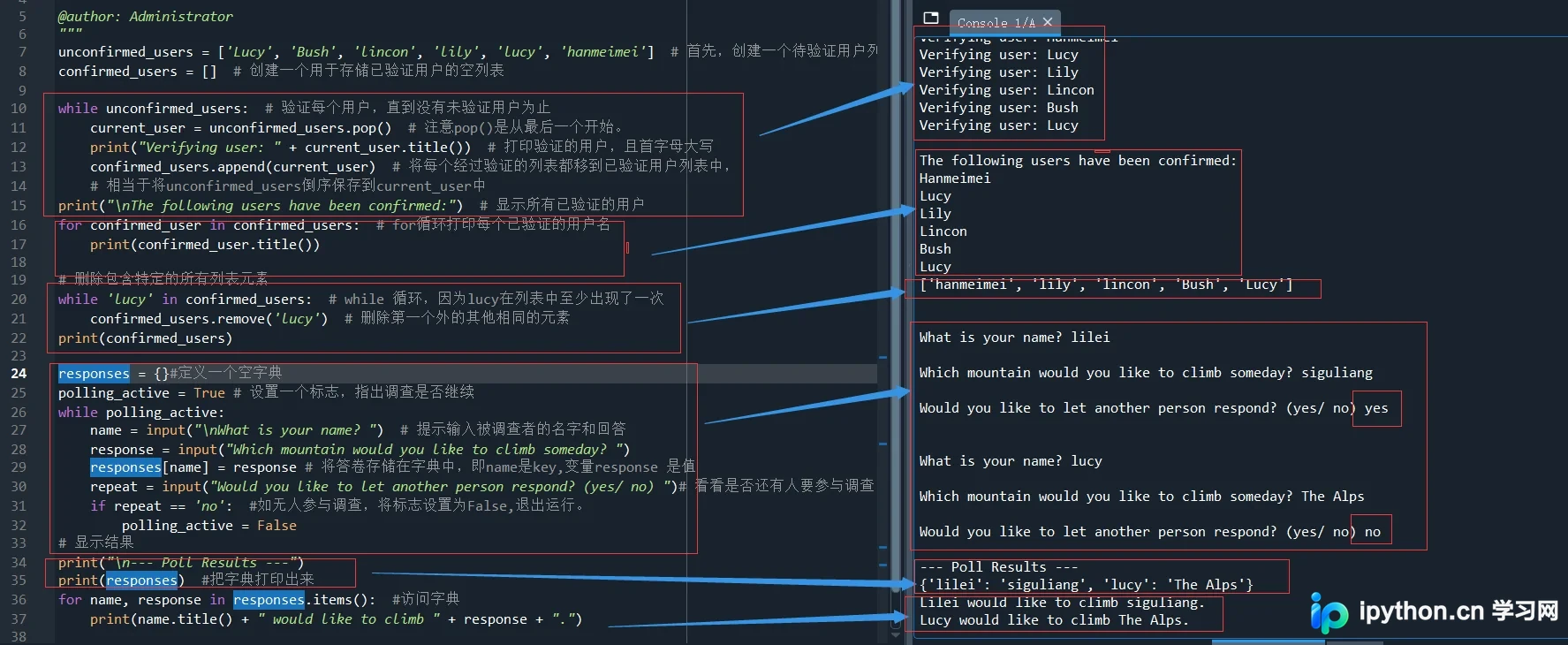
Verifying user: Hanmeimei Verifying user: Lucy Verifying user: Lily Verifying user: Jack Verifying user: Lincon Verifying user: Bush The following users have been confirmed: Hanmeimei Lucy Lily Jack Lincon Bush ['hanmeimei', 'lily', 'jack', 'lincon', 'Bush', 'Lucy']#注意保留的是最后一个Lucy
2) 处理字典中的数据
responses = {}#定义一个空字典
polling_active = True # 设置一个标志,指出调查是否继续
while polling_active:
    name = input("\nWhat is your name? ")  # 提示输入被调查者的名字和回答
    response = input("Which mountain would you like to climb someday? ")
    responses[name] = response # 将答卷存储在字典中,即name是key,变量response 是值
    repeat = input("Would you like to let another person respond? (yes/ no) ")# 看看是否还有人要参与调查
    if repeat == 'no':  #如无人参与调查,将标志设置为False,退出运行。
        polling_active = False
# 调查结束,显示结果
print("\n--- Poll Results ---")
print(responses)  #把字典打印出来
for name, response in responses.items():  #访问字典
    print(name.title() + " would like to climb " + response + ".")
运行结果:
What is your name? lilei Which mountain would you like to climb someday? siguliang Would you like to let another person respond? (yes/ no) yes What is your name? Lucy Which mountain would you like to climb someday? The Alps Would you like to let another person respond? (yes/ no) no --- Poll Results --- {'lilei': 'siguliang', 'Lucy': 'The Alps'} Lilei would like to climb siguliang. Lucy would like to climb The Alps.
实际运行:(为显示全,已删除部分unconfirmed_users中的名字)
到此这篇关于python入门语句基础之if语句、while语句的文章就介绍到这了,更多相关python if语句while语句内容请搜索本站以前的文章或继续浏览下面的相关文章希望大家以后多多支持本站!
本站声明
本文内容仅供参考,不代表本站观点。转载或引用请注明出处。如发现内容问题,请通过联系我们页面反馈。















