


Python实现向好友发送微信消息优化篇

本文详细解析了利用Python向微信好友发送消息的技术实现,重点展示了从C语言混合编程到纯Python汇编生成的三次优化过程。通过减少无用机器码、直接构造内存数据及使用Keystone库自动生成机器码,显著提升了执行效率与代码简洁性。
前言
此前已介绍如何将机器码写入内存并调用,本节重点讨论如何进一步优化该过程。
使用Python向微信好友发送消息
第二次优化
回顾C语言代码
void SendText( wchar_t* wsTextMsg) {
    // 发送的好友,filehelper是文件传输助手
	wchar_t wsWxId[0x10] = L"filehelper";
	WxBaseStruct wxWxid(wsWxId);
	// 发送的消息内容
	WxBaseStruct wxTextMsg(wsTextMsg);
	wchar_t** pWxmsg = &wxTextMsg.buffer;
	char buffer[0x3B0] = { 0 };
	char wxNull[0x100] = { 0 };
	DWORD dllBaseAddress = (DWORD)GetModuleHandleA("WeChatWin.dll");
	// 发消息的函数call地址
	DWORD callAddress = dllBaseAddress + 0x521D30;
	__asm {
		lea eax, wxNull;
		push 0x1;
		push eax;
		mov edi, pWxmsg;
		push edi;
		lea edx, wxWxid;
		lea ecx, buffer;
		call callAddress;
		add esp, 0xC;
	}
}
上述代码中真正执行发送操作的是汇编部分,之前的C代码仅负责组装内存数据。因此,我们可以尝试用Python来组装数据,仅将后续汇编部分转换为机器码并写入内存进行调用,从而省去大量无用的机器码。
修改后的SendText函数如下
wchar_t wsWxId[0x10] = L"filehelper"; wchar_t wsTextMsg[0x100] = L"test"; WxBaseStruct wxWxid(wsWxId); WxBaseStruct wxTextMsg(wsTextMsg); wchar_t** pWxmsg = &wxTextMsg.buffer; char buffer[0x3B0] = { 0 }; char wxNull[0x100] = { 0 }; DWORD dllBaseAddress = (DWORD)GetModuleHandleA("WeChatWin.dll");; DWORD callAddress = dllBaseAddress + 0x521D30; void SendText() { __asm { lea eax, wxNull; push 0x1; push eax; mov edi, pWxmsg; push edi; lea edx, wxWxid; lea ecx, buffer; call callAddress; add esp, 0xC; } }
汇编代码:
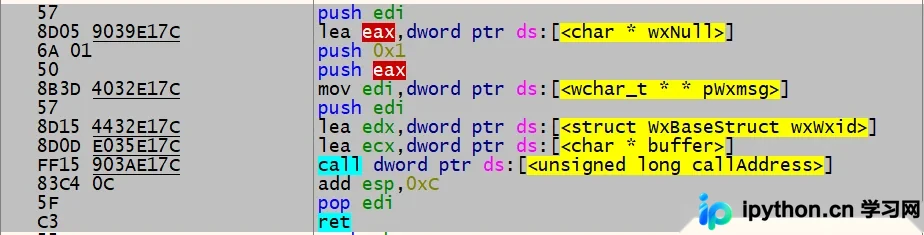
方括号内包含的类型和变量名实际上代表地址,只需将这些地址替换为Python构造的地址即可。
完整代码如下:
import os
import pymem
import ctypes
import time
def convert_addr(addr):
    if isinstance(addr, int):
        addr = hex(addr)
    if addr.startswith("0x") or addr.startswith("0X"):
        addr = addr[2:]
    if len(addr) < 8:
        addr = (8-len(addr))*'0' + addr
    tmp = []
    for i in range(0, 8, 2):
        tmp.append(addr[i:i+2])
    tmp.reverse()
    return ''.join(tmp)
def WxBaseStruct(process_handle, content):
    struct_address = pymem.memory.allocate_memory(process_handle, 20)
    bcontent = content.encode('utf-16le')
    content_address = pymem.memory.allocate_memory(process_handle, len(bcontent)+16)
    pymem.ressources.kernel32.WriteProcessMemory(process_handle, content_address, bcontent, len(bcontent), None)
    pymem.memory.write_int(process_handle, struct_address, content_address)
    pymem.memory.write_int(process_handle, struct_address+0x4, len(content))
    pymem.memory.write_int(process_handle, struct_address+0x8, len(content)*2)
    pymem.memory.write_int(process_handle, struct_address+0xC, 0)
    pymem.memory.write_int(process_handle, struct_address+0x10, 0)
    return struct_address, content_address
def start_thread(process_handle, address, params=None):
    params = params or 0
    NULL_SECURITY_ATTRIBUTES = ctypes.cast(0, pymem.ressources.structure.LPSECURITY_ATTRIBUTES)
    thread_h = pymem.ressources.kernel32.CreateRemoteThread(
        process_handle,
        NULL_SECURITY_ATTRIBUTES,
        0,
        address,
        params,
        0,
        ctypes.byref(ctypes.c_ulong(0))
    )
    last_error = ctypes.windll.kernel32.GetLastError()
    if last_error:
        pymem.logger.warning('Got an error in start thread, code: %s' % last_error)
    pymem.ressources.kernel32.WaitForSingleObject(thread_h, -1)
    return thread_h
def main(wxpid, wxid, msg):
    process_handle = pymem.process.open(wxpid)
    wxNull_address = pymem.memory.allocate_memory(process_handle, 0x100)
    buffer_address = pymem.memory.allocate_memory(process_handle, 0x3B0)
    wxid_struct_address, wxid_address = WxBaseStruct(process_handle, wxid)
    msg_struct_address, msg_address = WxBaseStruct(process_handle, msg)
    process_WeChatWin_handle = pymem.process.module_from_name(process_handle, "WeChatWin.dll")
    call_address = process_WeChatWin_handle.lpBaseOfDll + 0x521D30
    call_p_address = pymem.memory.allocate_memory(process_handle, 4)
    pymem.memory.write_int(process_handle, call_p_address, call_address)
    format_code = '''
    57
    8D05 {wxNull}
    6A 01
    50
    8D3D {wxTextMsg}
    57
    8D15 {wxWxid}
    8D0D {buffer}
    FF15 {callAddress}
    83C4 0C
    5F
    C3
    '''
    shellcode = format_code.format(wxNull=convert_addr(wxNull_address),
                wxTextMsg=convert_addr(msg_struct_address),
                wxWxid=convert_addr(wxid_struct_address),
                buffer=convert_addr(buffer_address),
                callAddress=convert_addr(call_p_address))
    shellcode = bytes.fromhex(shellcode.replace(' ', '').replace('\n', ''))
    shellcode_address = pymem.memory.allocate_memory(process_handle, len(shellcode)+5)
    pymem.ressources.kernel32.WriteProcessMemory(process_handle, shellcode_address, shellcode, len(shellcode), None)
    thread_h = start_thread(process_handle, shellcode_address)
    time.sleep(0.5)
    pymem.memory.free_memory(process_handle, wxNull_address)
    pymem.memory.free_memory(process_handle, buffer_address)
    pymem.memory.free_memory(process_handle, wxid_struct_address)
    pymem.memory.free_memory(process_handle, wxid_address)
    pymem.memory.free_memory(process_handle, msg_struct_address)
    pymem.memory.free_memory(process_handle, msg_address)
    pymem.memory.free_memory(process_handle, call_p_address)
    pymem.memory.free_memory(process_handle, shellcode_address)
    pymem.process.close_handle(process_handle)
if __name__ == "__main__":
    wxpid = 16892
    wxid = "filehelper"
    msg = "python test"
    main(wxpid, wxid, msg)
第三次优化
直接在Python中编写汇编代码,并利用Python的keystone库自动将其转换为机器码写入内存。
# -*- coding: utf-8 -*-
import os
import pymem
import ctypes
import time
from keystone import Ks, KS_ARCH_X86, KS_MODE_32
def asm2code(asm_code, syntax=0):
    ks = Ks(KS_ARCH_X86, KS_MODE_32)
    bytes_code, _ = ks.asm(asm_code, as_bytes=True)
    return bytes_code
def WxBaseStruct(process_handle, content):
    struct_address = pymem.memory.allocate_memory(process_handle, 20)
    bcontent = content.encode('utf-16le')
    content_address = pymem.memory.allocate_memory(process_handle, len(bcontent)+16)
    pymem.ressources.kernel32.WriteProcessMemory(process_handle, content_address, bcontent, len(bcontent), None)
    pymem.memory.write_int(process_handle, struct_address, content_address)
    pymem.memory.write_int(process_handle, struct_address+0x4, len(content))
    pymem.memory.write_int(process_handle, struct_address+0x8, len(content)*2)
    pymem.memory.write_int(process_handle, struct_address+0xC, 0)
    pymem.memory.write_int(process_handle, struct_address+0x10, 0)
    return struct_address, content_address
def start_thread(process_handle, address, params=None):
    params = params or 0
    NULL_SECURITY_ATTRIBUTES = ctypes.cast(0, pymem.ressources.structure.LPSECURITY_ATTRIBUTES)
    thread_h = pymem.ressources.kernel32.CreateRemoteThread(
        process_handle,
        NULL_SECURITY_ATTRIBUTES,
        0,
        address,
        params,
        0,
        ctypes.byref(ctypes.c_ulong(0))
    )
    last_error = ctypes.windll.kernel32.GetLastError()
    if last_error:
        pymem.logger.warning('Got an error in start thread, code: %s' % last_error)
    pymem.ressources.kernel32.WaitForSingleObject(thread_h, -1)
    return thread_h
def main(wxpid, wxid, msg):
    process_handle = pymem.process.open(wxpid)
    wxNull_address = pymem.memory.allocate_memory(process_handle, 0x100)
    buffer_address = pymem.memory.allocate_memory(process_handle, 0x3B0)
    wxid_struct_address, wxid_address = WxBaseStruct(process_handle, wxid)
    msg_struct_address, msg_address = WxBaseStruct(process_handle, msg)
    process_WeChatWin_handle = pymem.process.module_from_name(process_handle, "WeChatWin.dll")
    call_address = process_WeChatWin_handle.lpBaseOfDll + 0x521D30
    call_p_address = pymem.memory.allocate_memory(process_handle, 4)
    pymem.memory.write_int(process_handle, call_p_address, call_address)
    format_asm_code = '''
    push edi;
    lea eax,dword ptr ds:[{wxNull:#02x}];
    push 0x1;
    push eax;
    lea edi,dword ptr ds:[{wxTextMsg:#02x}];
    push edi;
    lea edx,dword ptr ds:[{wxWxid:#02x}];
    lea ecx,dword ptr ds:[{buffer:#02x}];
    call dword ptr ds:[{callAddress:#02x}];
    add esp, 0xC;
    pop edi;
    ret;
    '''
    asm_code = format_asm_code.format(wxNull=wxNull_address,
                wxTextMsg=msg_struct_address,
                wxWxid=wxid_struct_address,
                buffer=buffer_address,
                callAddress=call_p_address)
    shellcode = asm2code(asm_code.encode())
    shellcode_address = pymem.memory.allocate_memory(process_handle, len(shellcode)+5)
    pymem.ressources.kernel32.WriteProcessMemory(process_handle, shellcode_address, shellcode, len(shellcode), None)
    thread_h = start_thread(process_handle, shellcode_address)
    time.sleep(0.5)
    pymem.memory.free_memory(process_handle, wxNull_address)
    pymem.memory.free_memory(process_handle, buffer_address)
    pymem.memory.free_memory(process_handle, wxid_struct_address)
    pymem.memory.free_memory(process_handle, wxid_address)
    pymem.memory.free_memory(process_handle, msg_struct_address)
    pymem.memory.free_memory(process_handle, msg_address)
    pymem.memory.free_memory(process_handle, call_p_address)
    pymem.memory.free_memory(process_handle, shellcode_address)
    pymem.process.close_handle(process_handle)
if __name__ == "__main__":
    wxpid = 18604
    wxid = "filehelper"
    msg = "python test msg"
    main(wxpid, wxid, msg)
至此,关于Python实现向好友发送微信消息的优化篇介绍完毕。更多相关Python微信消息内容请搜索本站以前的文章或继续浏览下面的相关文章,希望大家以后多多支持本站!
本站声明
本文内容仅供参考,不代表本站观点。转载或引用请注明出处。如发现内容问题,请通过联系我们页面反馈。















