


Python3 math.ceil()函数详解:语法、参数与向上取整实例

发布时间:2026-10-13 |
6人浏览过
本文详细介绍Python3中math模块的ceil()函数,用于返回大于或等于输入数值的最小整数。文章涵盖函数语法、导入math模块的必要性、参数说明及返回值类型,并提供完整的代码运行实例,对比ceil、floor与round函数的行为差异,帮助开发者准确掌握数值取整技巧。
描述
ceil(x) 函数用于计算并返回一个大于或等于 x 的最小整数值。
语法
以下是调用 ceil() 方法的标准语法格式:
import math

math.ceil( x )
注意:ceil() 并非内置函数,无法直接访问,必须先导入 math 模块,并通过该模块的静态对象进行调用。
参数
x -- 一个数值表达式,作为处理对象。
返回值
函数执行后,返回一个大于或等于 x 的最小整数值。
实例
以下代码展示了如何使用 ceil() 方法:
#!/usr/bin/python3
import math  # 导入 math 模块

print ("math.ceil(-45.17) : ", math.ceil(-45.17))
print ("math.ceil(100.12) : ", math.ceil(100.12))
print ("math.ceil(100.72) : ", math.ceil(100.72))
print ("math.ceil(math.pi) : ", math.ceil(math.pi))
运行上述实例后,控制台输出结果如下:
math.ceil(-45.17) : -45
math.ceil(100.12) : 101
math.ceil(100.72) : 101
math.ceil(math.pi) : 4
python 向上取整ceil 向下取整floor 四舍五入round
#encoding:utf-8
import math

#向上取整
print "math.ceil---"
print "math.ceil(2.3) => ", math.ceil(2.3)
print "math.ceil(2.6) => ", math.ceil(2.6)

#向下取整
print "\nmath.floor---"
print "math.floor(2.3) => ", math.floor(2.3)
print "math.floor(2.6) => ", math.floor(2.6)

#四舍五入
print "\nround---"
print "round(2.3) => ", round(2.3)
print "round(2.6) => ", round(2.6)

#这三个的返回结果都是浮点型
print "\n\nNOTE:every result is type of float"
print "math.ceil(2) => ", math.ceil(2)
print "math.floor(2) => ", math.floor(2)
print "round(2) => ", round(2)
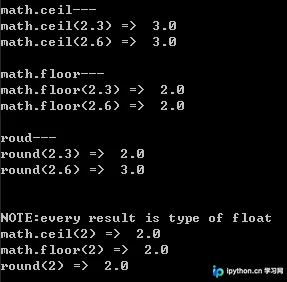
运行结果:
本站声明
本文内容仅供参考,不代表本站观点。转载或引用请注明出处。如发现内容问题,请通过联系我们页面反馈。















