


Python实现Dijkstra算法与A*改进:机器人路径规划详解

本文详细介绍如何使用Python实现Dijkstra算法进行机器人路径规划,涵盖算法原理、集合操作及代码实现。同时对比分析A*算法通过引入启发式函数优化搜索效率的方法,结合PythonRobotics项目源码,提供从理论到实践的完整路径规划解决方案。
前言
在机器人运动过程中,为了实现有效避障并获取最短路径,必须采用特定的路径规划算法。常见的路径规划方法包括Dijkstra算法和A*算法等。GitHub上的开源项目PythonRobotics提供了高质量的源代码与参考实现,通过研读这些代码,可以深入理解Dijkstra算法的核心机制与应用细节。
一、算法原理
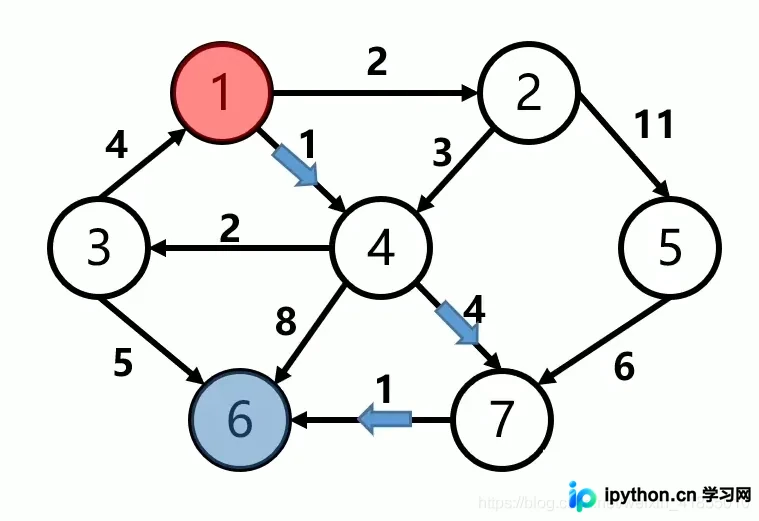
如图所示,Dijkstra算法旨在解决有向加权图中的最短路径查找问题。图中红色节点1标识起始位置,蓝色节点6标识目标位置。连接节点的箭头上的数值代表两点间的距离,即在模型中定义的代价(cost)。
该算法依赖两个关键集合:open_set(开集)和closed_set(闭集),并遵循以下逻辑步骤执行:
- 将初始节点加入open_set中;
- 从open_set中选取代价最小的节点,将其移至closed_set并设为当前节点;
- 将与当前节点相邻的节点加入open_set,若计算出的新代价更小,则更新该节点的代价;
- 重复步骤2和3,直至找到终点节点。
需要注意的是,open_set中的节点代价是动态变化的,而closed_set中的节点代价已确定为最小值,这也是“open”与“close”命名的由来。
之所以closed_set中的代价是最小的,是因为算法采用了贪心策略。一旦节点被加入closed_set,意味着从初始点到该节点的距离已小于或等于到open_set中任何节点的距离,因此不可能再找到比当前更小的路径代价。
二、程序代码
"""

Grid based Dijkstra planning

author: Atsushi Sakai(@Atsushi_twi)

"""

import matplotlib.pyplot as plt
import math

show_animation = True


class Dijkstra:

    def __init__(self, ox, oy, resolution, robot_radius):
        """
        Initialize map for a star planning

        ox: x position list of Obstacles [m]
        oy: y position list of Obstacles [m]
        resolution: grid resolution [m]
        rr: robot radius[m]
        """

        self.min_x = None
        self.min_y = None
        self.max_x = None
        self.max_y = None
        self.x_width = None
        self.y_width = None
        self.obstacle_map = None

        self.resolution = resolution
        self.robot_radius = robot_radius
        self.calc_obstacle_map(ox, oy)
        self.motion = self.get_motion_model()

    class Node:
        def __init__(self, x, y, cost, parent_index):
            self.x = x  # index of grid
            self.y = y  # index of grid
            self.cost = cost
            self.parent_index = parent_index  # index of previous Node

        def __str__(self):
            return str(self.x) + "," + str(self.y) + "," + str(
                self.cost) + "," + str(self.parent_index)

    def planning(self, sx, sy, gx, gy):
        """
        dijkstra path search

        input:
            s_x: start x position [m]
            s_y: start y position [m]
            gx: goal x position [m]
            gx: goal x position [m]

        output:
            rx: x position list of the final path
            ry: y position list of the final path
        """

        start_node = self.Node(self.calc_xy_index(sx, self.min_x),
                               self.calc_xy_index(sy, self.min_y), 0.0, -1)
        goal_node = self.Node(self.calc_xy_index(gx, self.min_x),
                              self.calc_xy_index(gy, self.min_y), 0.0, -1)

        open_set, closed_set = dict(), dict()
        open_set[self.calc_index(start_node)] = start_node

        while 1:
            c_id = min(open_set, key=lambda o: open_set[o].cost)
            current = open_set[c_id]

            # show graph
            if show_animation:  # pragma: no cover
                plt.plot(self.calc_position(current.x, self.min_x),
                         self.calc_position(current.y, self.min_y), "xc")
                # for stopping simulation with the esc key.
                plt.gcf().canvas.mpl_connect(
                    'key_release_event',
                    lambda event: [exit(0) if event.key == 'escape' else None])
                if len(closed_set.keys()) % 10 == 0:
                    plt.pause(0.001)

            if current.x == goal_node.x and current.y == goal_node.y:
                print("Find goal")
                goal_node.parent_index = current.parent_index
                goal_node.cost = current.cost
                break

            # Remove the item from the open set
            del open_set[c_id]

            # Add it to the closed set
            closed_set[c_id] = current

            # expand search grid based on motion model
            for move_x, move_y, move_cost in self.motion:
                node = self.Node(current.x + move_x,
                                 current.y + move_y,
                                 current.cost + move_cost, c_id)
                n_id = self.calc_index(node)

                if n_id in closed_set:
                    continue

                if not self.verify_node(node):
                    continue

                if n_id not in open_set:
                    open_set[n_id] = node  # Discover a new node
                else:
                    if open_set[n_id].cost >= node.cost:
                        # This path is the best until now. record it!
                        open_set[n_id] = node

        rx, ry = self.calc_final_path(goal_node, closed_set)

        return rx, ry

    def calc_final_path(self, goal_node, closed_set):
        # generate final course
        rx, ry = [self.calc_position(goal_node.x, self.min_x)], [
            self.calc_position(goal_node.y, self.min_y)]
        parent_index = goal_node.parent_index
        while parent_index != -1:
            n = closed_set[parent_index]
            rx.append(self.calc_position(n.x, self.min_x))
            ry.append(self.calc_position(n.y, self.min_y))
            parent_index = n.parent_index

        return rx, ry

    def calc_position(self, index, minp):
        pos = index * self.resolution + minp
        return pos

    def calc_xy_index(self, position, minp):
        return round((position - minp) / self.resolution)

    def calc_index(self, node):
        return (node.y - self.min_y) * self.x_width + (node.x - self.min_x)

    def verify_node(self, node):
        px = self.calc_position(node.x, self.min_x)
        py = self.calc_position(node.y, self.min_y)

        if px < self.min_x:
            return False
        if py < self.min_y:
            return False
        if px >= self.max_x:
            return False
        if py >= self.max_y:
            return False

        if self.obstacle_map[node.x][node.y]:
            return False

        return True

    def calc_obstacle_map(self, ox, oy):

        self.min_x = round(min(ox))
        self.min_y = round(min(oy))
        self.max_x = round(max(ox))
        self.max_y = round(max(oy))
        print("min_x:", self.min_x)
        print("min_y:", self.min_y)
        print("max_x:", self.max_x)
        print("max_y:", self.max_y)

        self.x_width = round((self.max_x - self.min_x) / self.resolution)
        self.y_width = round((self.max_y - self.min_y) / self.resolution)
        print("x_width:", self.x_width)
        print("y_width:", self.y_width)

        # obstacle map generation
        self.obstacle_map = [[False for _ in range(self.y_width)]
                             for _ in range(self.x_width)]
        for ix in range(self.x_width):
            x = self.calc_position(ix, self.min_x)
            for iy in range(self.y_width):
                y = self.calc_position(iy, self.min_y)
                for iox, ioy in zip(ox, oy):
                    d = math.hypot(iox - x, ioy - y)
                    if d <= self.robot_radius:
                        self.obstacle_map[ix][iy] = True
                        break

    @staticmethod
    def get_motion_model():
        # dx, dy, cost
        motion = [[1, 0, 1],
                  [0, 1, 1],
                  [-1, 0, 1],
                  [0, -1, 1],
                  [-1, -1, math.sqrt(2)],
                  [-1, 1, math.sqrt(2)],
                  [1, -1, math.sqrt(2)],
                  [1, 1, math.sqrt(2)]]

        return motion


def main():
    print(__file__ + " start!!")

    # start and goal position
    sx = -5.0  # [m]
    sy = -5.0  # [m]
    gx = 50.0  # [m]
    gy = 50.0  # [m]
    grid_size = 2.0  # [m]
    robot_radius = 1.0  # [m]

    # set obstacle positions
    ox, oy = [], []
    for i in range(-10, 60):
        ox.append(i)
        oy.append(-10.0)
    for i in range(-10, 60):
        ox.append(60.0)
        oy.append(i)
    for i in range(-10, 61):
        ox.append(i)
        oy.append(60.0)
    for i in range(-10, 61):
        ox.append(-10.0)
        oy.append(i)
    for i in range(-10, 40):
        ox.append(20.0)
        oy.append(i)
    for i in range(0, 40):
        ox.append(40.0)
        oy.append(60.0 - i)

    if show_animation:  # pragma: no cover
        plt.plot(ox, oy, ".k")
        plt.plot(sx, sy, "og")
        plt.plot(gx, gy, "xb")
        plt.grid(True)
        plt.axis("equal")

    dijkstra = Dijkstra(ox, oy, grid_size, robot_radius)
    rx, ry = dijkstra.planning(sx, sy, gx, gy)

    if show_animation:  # pragma: no cover
        plt.plot(rx, ry, "-r")
        plt.pause(0.01)
        plt.show()


if __name__ == '__main__':
    main()
三、运行结果
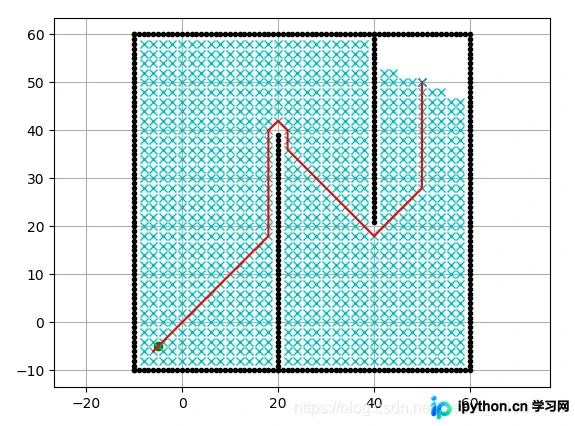
四、 A*算法:Dijkstra算法的改进
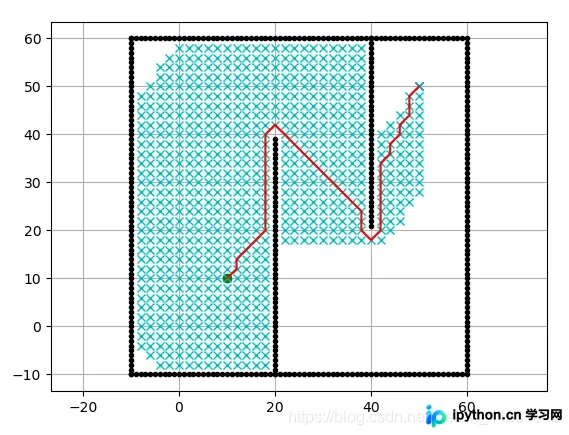
Dijkstra算法本质上属于贪心搜索,其时间复杂度为O(n^2)。为了减少无效搜索次数,可以引入启发式函数(heuristic),例如计算当前节点到目标节点的距离。在选择open_set元素时,将评估函数调整为cost + heuristic,从而为搜索提供方向性指引,有效避免盲目搜索。通过运行PythonRobotics中的Astar代码,可获得如下优化结果:
总结
至此,关于使用Python编写Dijkstra算法进行机器人路径规划的详细介绍已完成。如需了解更多Python实现Dijkstra算法的相关内容,建议查阅本站往期文章或继续浏览后续系列教程,感谢大家的支持。
本站声明
本文内容仅供参考,不代表本站观点。转载或引用请注明出处。如发现内容问题,请通过联系我们页面反馈。















