


Python密码生成器:怎么验证生成结果符合安全策略

secrets 模块进行随机采样,有限长度下的纯离散抽样仍可能遗漏某些字符类别或产生不可预期的弱模式;只有配合独立断言验证与自动化批量抽样,才能真正保证生成输出百分之百合规。
一、为什么仅靠随机抽取不够:验证的必要性
编写 Python 密码生成器时,很多初学者容易陷入一个直觉陷阱:只要在字符候选池中放入了大写字母、小写字母、数字和特殊符号,再调用 secrets.choice() 连续抽取 12 次,产出的字符串就必然是符合要求的强密码。
在概率论与密码工程中,这种假设并不成立。假设字符池总共有 94 个可打印 ASCII 字符,其中特殊符号占 32 个。每次抽取是独立的伯努利试验,生成 12 位密码时完全不包含任何特殊字符的概率虽然不高,但在批量生成场景下(例如为系统批量初始化 10,000 个用户凭据),必然会出现一定比例不达标的候选串。此外,纯随机过程也有极低概率产生 aaaa、1234 等连续或可预测片段。
因此,一个合格的密码生成器必须包含两个解耦的组件:生成器(Generator)与策略验证器(Policy Validator)。验证器扮演守门员角色,任何交付给用户或落库的密码都必须通过严格的策略核验。
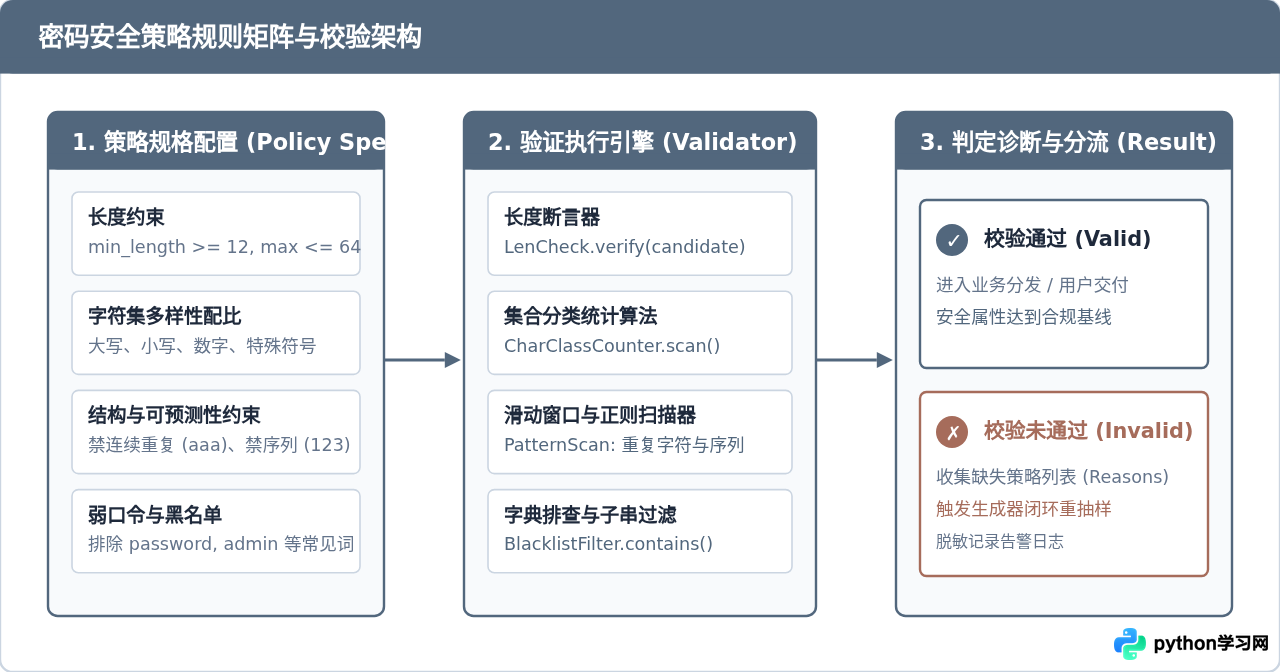
二、安全策略的数据模型与验证器实现
验证机制的第一步是将安全要求转化为清晰的数据结构。我们使用 Python 内置的 dataclasses 定义策略规则,并实现一个结构化的验证函数。该函数不仅返回布尔判断结果,还会返回具体的违规原因列表(Diagnostic Reasons),便于调试和日志审计。
import string
import re
from dataclasses import dataclass, field
from typing import List, Tuple, Set

@dataclass(frozen=True)
class PasswordPolicy:
    """定义密码安全策略规则"""
    min_length: int = 12
    max_length: int = 64
    min_uppercase: int = 1
    min_lowercase: int = 1
    min_digits: int = 1
    min_symbols: int = 1
    allowed_symbols: str = "!@#$%^&*()-_=+[]{}|;:,.<>?/~"
    max_consecutive_repeats: int = 2      # 允许单字符最大连续出现次数,如2表示禁止 aaa
    disallowed_sequences: bool = True     # 是否禁止连续自然序列(如 123, abc)
    blacklist: Tuple[str, ...] = ("password", "admin", "root", "qwerty")

def validate_password_policy(password: str, policy: PasswordPolicy) -> Tuple[bool, List[str]]:
    """
    对候选密码执行全量策略验证
    返回 (is_valid, failure_reasons)
    """
    failures: List[str] = []

    # 1. 长度边界验证
    pwd_len = len(password)
    if pwd_len < policy.min_length:
        failures.append(f"长度过短:当前为 {pwd_len},要求不低于 {policy.min_length}")
    if pwd_len > policy.max_length:
        failures.append(f"长度超出上限:当前为 {pwd_len},要求不超过 {policy.max_length}")

    # 2. 字符集分类计数
    upper_set = set(string.ascii_uppercase)
    lower_set = set(string.ascii_lowercase)
    digit_set = set(string.digits)
    symbol_set = set(policy.allowed_symbols)

    upper_count = sum(1 for c in password if c in upper_set)
    lower_count = sum(1 for c in password if c in lower_set)
    digit_count = sum(1 for c in password if c in digit_set)
    symbol_count = sum(1 for c in password if c in symbol_set)

    # 检查非法字符(不在允许的四类字符集中)
    allowed_universe = upper_set | lower_set | digit_set | symbol_set
    illegal_chars = set(password) - allowed_universe
    if illegal_chars:
        failures.append(f"包含未定义字符:{sorted(list(illegal_chars))}")

    if upper_count < policy.min_uppercase:
        failures.append(f"大写字母不足:当前 {upper_count},要求至少 {policy.min_uppercase}")
    if lower_count < policy.min_lowercase:
        failures.append(f"小写字母不足:当前 {lower_count},要求至少 {policy.min_lowercase}")
    if digit_count < policy.min_digits:
        failures.append(f"数字不足:当前 {digit_count},要求至少 {policy.min_digits}")
    if symbol_count < policy.min_symbols:
        failures.append(f"特殊符号不足:当前 {symbol_count},要求至少 {policy.min_symbols}")

    # 3. 连续重复单字符排查(例如连续3个相同字符)
    if policy.max_consecutive_repeats > 0:
        pattern = rf"(.)\1{{{policy.max_consecutive_repeats},}}"
        if re.search(pattern, password):
            failures.append(f"存在超过 {policy.max_consecutive_repeats} 次连续重复的字符")

    # 4. 连续递增/递减序列排查(例如 abc, cba, 123, 321)
    if policy.disallowed_sequences and len(password) >= 3:
        for i in range(len(password) - 2):
            c1, c2, c3 = ord(password[i]), ord(password[i+1]), ord(password[i+2])
            if (c2 == c1 + 1 and c3 == c2 + 1) or (c2 == c1 - 1 and c3 == c2 - 1):
                failures.append(f"包含简单递变序列:{password[i:i+3]}")
                break

    # 5. 黑名单/弱口令敏感词检查
    lowered = password.lower()
    for word in policy.blacklist:
        if word.lower() in lowered:
            failures.append(f"包含弱口令黑名单敏感词:'{word}'")
            break

    is_valid = len(failures) == 0
    return is_valid, failures
三、闭环流水线:生成与验证的集成
构建高可靠密码生成器时,业界主要采用两类实现思路:
- 防御性保底构造(Guaranteed Inclusion):先从每种必需字符集中分别保底抽取指定数量的字符,剩余位数再全局随机填充,最后使用 Fisher-Yates 算法进行混洗打乱。
- 闭环拦截重试(Generate-and-Verify Loop):无论前端采用何种构造逻辑,生成的候选字符串都必须送入
validate_password_policy()裁决。若验证失败,则重新抽样,直到满足策略或达到安全重试上限。
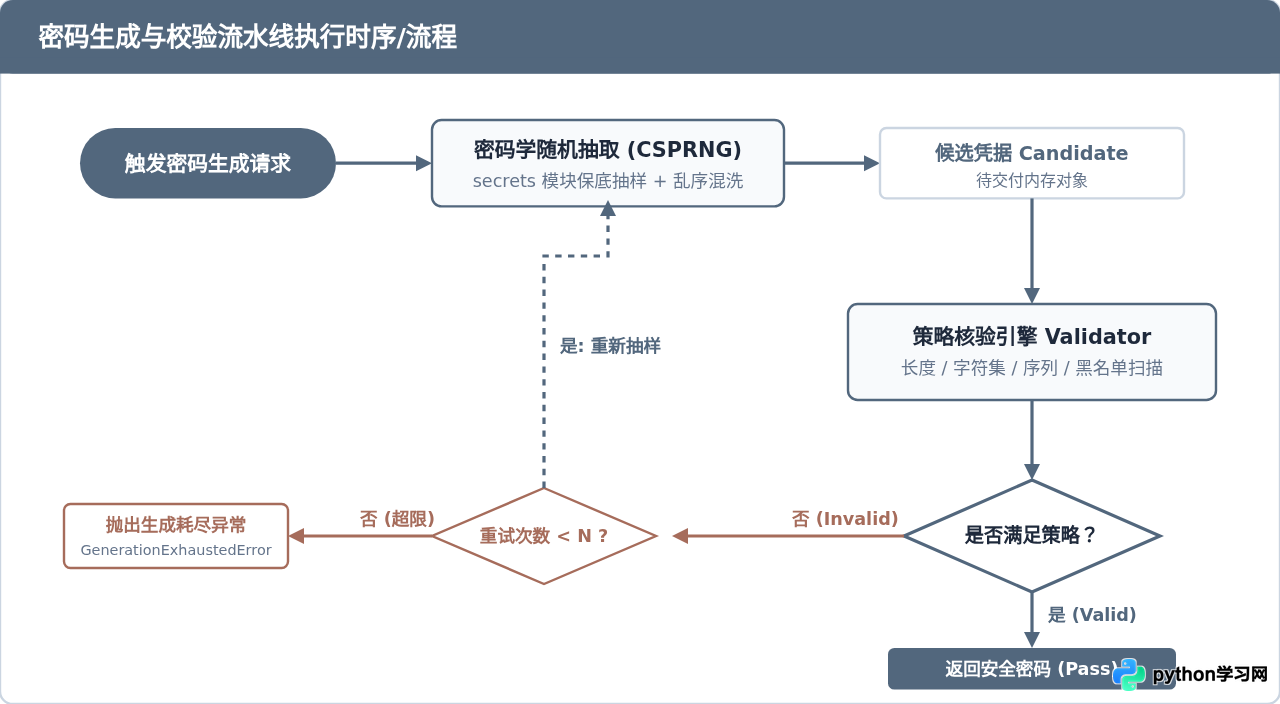
将保底抽取与验证器结合的完整工程代码如下:
import secrets

class PasswordGenerationError(Exception):
    """当生成过程达到最大重试上限仍无法满足策略时抛出"""
    pass

def generate_secure_password(policy: PasswordPolicy, max_attempts: int = 50) -> str:
    """
    根据策略生成强密码,并经过策略验证器闭环确认
    """
    total_required = (policy.min_uppercase + policy.min_lowercase +
                      policy.min_digits + policy.min_symbols)
    if total_required > policy.min_length:
        raise ValueError("策略配置冲突:必需字符总数超过了设定的最小密码长度")

    upper_pool = string.ascii_uppercase
    lower_pool = string.ascii_lowercase
    digit_pool = string.digits
    symbol_pool = policy.allowed_symbols
    combined_pool = upper_pool + lower_pool + digit_pool + symbol_pool

    for attempt in range(1, max_attempts + 1):
        chars: List[str] = []

        # 1. 保底抽取:满足每个类别的最小配额
        chars.extend(secrets.choice(upper_pool) for _ in range(policy.min_uppercase))
        chars.extend(secrets.choice(lower_pool) for _ in range(policy.min_lowercase))
        chars.extend(secrets.choice(digit_pool) for _ in range(policy.min_digits))
        chars.extend(secrets.choice(symbol_pool) for _ in range(policy.min_symbols))

        # 2. 剩余位填充:从总字符集中随机填充
        remaining = policy.min_length - len(chars)
        chars.extend(secrets.choice(combined_pool) for _ in range(remaining))

        # 3. 密码学安全混洗(Fisher-Yates 算法)
        for i in range(len(chars) - 1, 0, -1):
            j = secrets.randbelow(i + 1)
            chars[i], chars[j] = chars[j], chars[i]

        candidate = "".join(chars)

        # 4. 独立验证器把关
        is_valid, reasons = validate_password_policy(candidate, policy)
        if is_valid:
            return candidate

    raise PasswordGenerationError(f"在尝试 {max_attempts} 次后仍未能生成符合策略的密码。最后失败原因: {reasons}")
四、三种验证实现方案的技术对比
在实际工程开发中,开发者往往在“复合正则表达式”、“显式分类统计”与“滑动窗口模式分析”之间权衡。下表与图示展示了这三种方案的特点与适用维度。
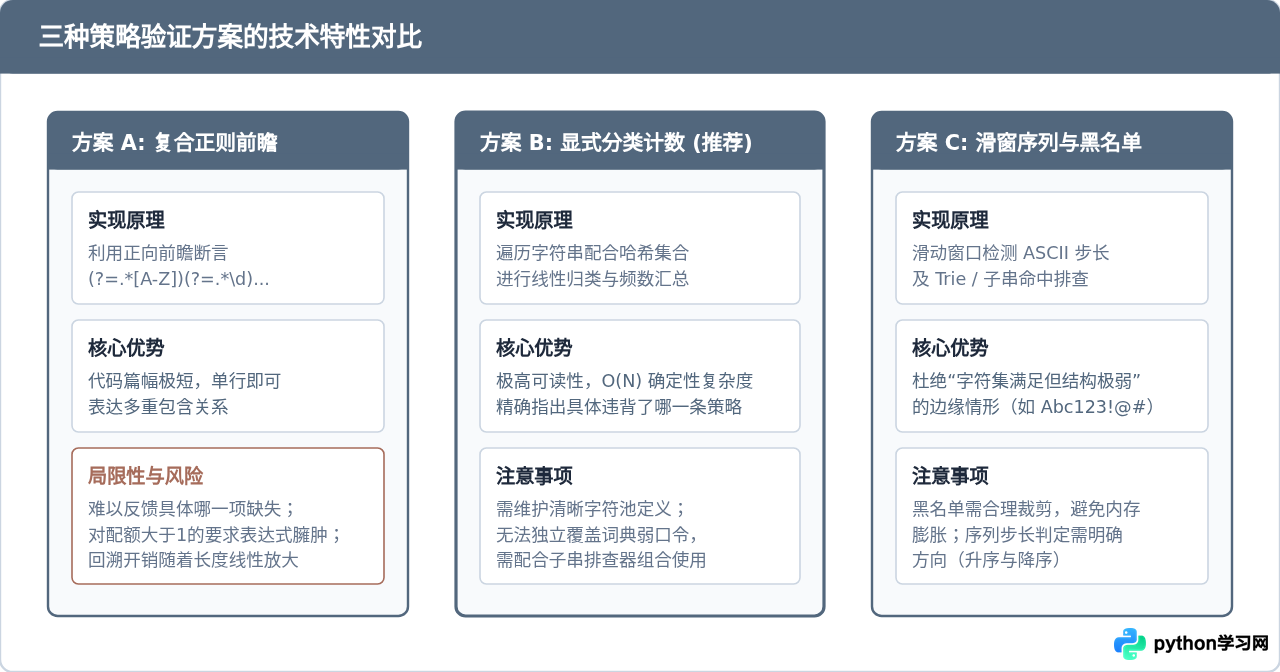
^(?=.*[a-z])(?=.*[A-Z])(?=.*\d)(?=.*[@$!%*?&])[A-Za-z\d@$!%*?&]{12,}$)。当生产环境生成失败时,单条正则无法告诉你究竟是“缺少特殊符号”还是“包含了非预期标点”,给排查带来极高的时间成本。模块化拆分的显式函数是企业级代码的首选。
五、自动化验证:确保生成器 100% 可靠的测试策略
编写完生成器与验证器之后,怎么证明这套工具在长期运行中绝对稳定?必须引入基于属性的测试(Property-based Testing)与蒙特卡洛批量抽样测试。
1. 批量蒙特卡洛断言测试
在测试用例中连续生成 10,000 次密码,验证通过率必须达到严格的 100%,无一漏网:
import unittest

class TestPasswordGeneratorPolicy(unittest.TestCase):
    def setUp(self):
        self.policy = PasswordPolicy(
            min_length=16,
            max_length=32,
            min_uppercase=2,
            min_lowercase=2,
            min_digits=2,
            min_symbols=2,
            max_consecutive_repeats=2,
            disallowed_sequences=True,
            blacklist=("admin", "test", "demo")
        )

    def test_batch_compliance_10000_samples(self):
        """批量测试 10,000 次生成结果,合规率必须为 100%"""
        sample_count = 10000
        for i in range(sample_count):
            pwd = generate_secure_password(self.policy)
            is_valid, reasons = validate_password_policy(pwd, self.policy)
            self.assertTrue(
                is_valid,
                f"第 {i+1} 次生成的密码 '{pwd}' 未通过策略校验!原因: {reasons}"
            )

    def test_extreme_boundary_policy(self):
        """测试极限策略:最小长度与各类别总和刚好相等"""
        boundary_policy = PasswordPolicy(
            min_length=4,
            max_length=4,
            min_uppercase=1,
            min_lowercase=1,
            min_digits=1,
            min_symbols=1
        )
        pwd = generate_secure_password(boundary_policy)
        self.assertEqual(len(pwd), 4)
        is_valid, _ = validate_password_policy(pwd, boundary_policy)
        self.assertTrue(is_valid)

if __name__ == "__main__":
    unittest.main()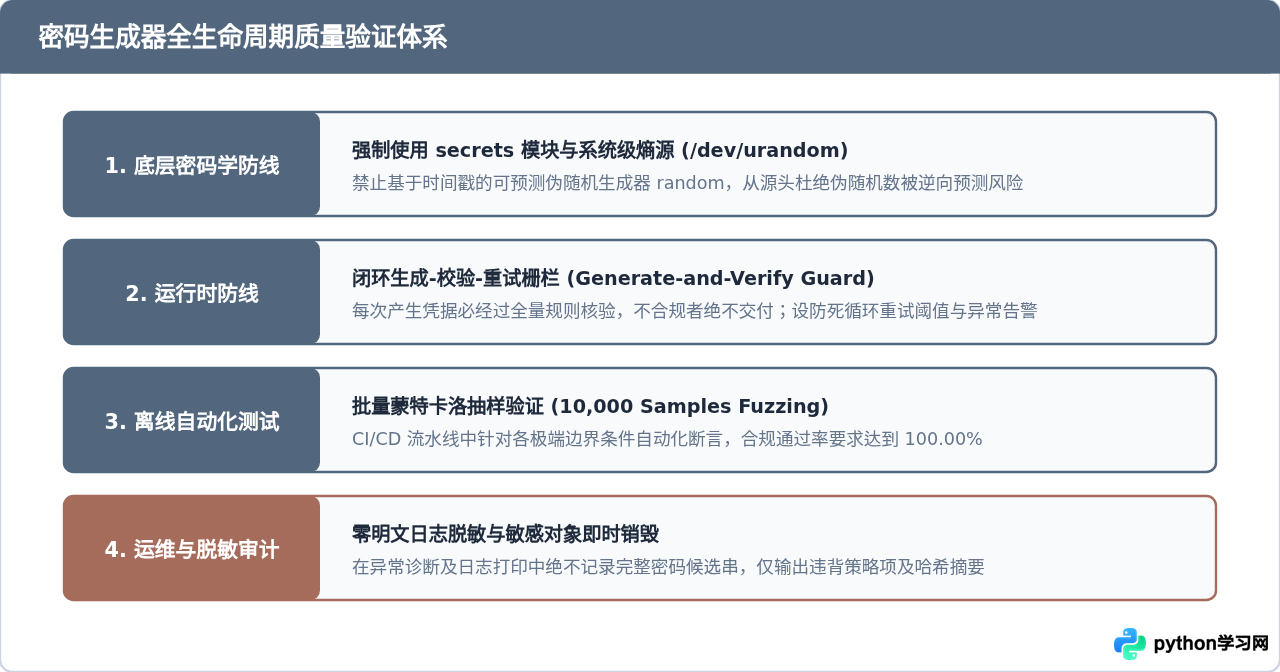
六、工程落地中的注意事项
-
严禁使用
random模块:Python 的标准random模块基于梅森旋转算法(Mersenne Twister),在收集到 624 个连续 32 位输出后,即可完全推导出内部状态,预测后续所有“随机数”。涉及密码生成必须无条件使用secrets模块。 -
特殊符号集的明确界定:不少系统对特殊符号有特定限制。例如,部分数据库或老旧 Shell 脚本对单引号
'、双引号"或反斜杠\会发生转义冲突。在PasswordPolicy中务必提供可配置的allowed_symbols白名单,并在验证器中明确拦截白名单外的字符。 -
日志安全与零明文原则:当密码生成失败抛出
PasswordGenerationError或记录审计日志时,切忌在异常信息或标准输出中直接打印明文候选密码。应该只打印失败的策略维度(如“大写字母缺少 1 位”),避免让生成过程本身成为凭据泄露通道。
本站声明
本文内容仅供参考,不代表本站观点。转载或引用请注明出处。如发现内容问题,请通过联系我们页面反馈。















