


Softmax分类器原理与Python实现解析

发布时间:2026-10-13 |
2人浏览过
本文解析Softmax函数在多分类问题中的应用,阐述其将N维向量映射为概率分布的特性。对比两种交叉熵损失函数的表达形式及其求导差异,并通过基于MNIST数据集的Python代码示例,展示Softmax分类器的训练过程与约85%的分类精度结果。
Softmax函数原理与特性
相较于自适应神经网络和感知器,Softmax采用更为简洁有效的方法来解决多分类问题。
- 在功能层面,Softmax实现了从N维输入向量到M维输出向量的映射。
- 其输出值的范围位于[0, 1]之间,且对于单个样本的所有输出值之和恒等于1。
- 这些输出结果可以隐式地表示样本属于各个类别的概率。
交叉熵损失函数解析
Softmax的损失函数通常采用多分类任务中常见的交叉熵,这里需要注意存在两种常见的表达形式。
- 经典的交叉熵形式为:L=-sum(y_right * log(y_pred)),具体计算方式如下。
- 简化版本则为:L = -Log(y_pred),具体计算方式如下。
这两种形式在求导过程中存在细微差异,但最终结果一致,且损失函数的含义相同。这是因为在第一种表达形式中,当预测类别不正确时,y_right等于0;而当预测类别正确时,y_right等于1。
因此,当y_right等于0时,该项对损失的贡献为0;当y_right等于1时,该项贡献为-log(y_pred)。
MNIST数据集实验与代码实现
接下来,基于MNIST数据集进行了一个多分类实验,整体分类精度达到了85%左右。
'''
softmax classifier for mnist

created on 2019.9.28
author: vince
'''
import math
import logging
import numpy
import random
import matplotlib.pyplot as plt
from tensorflow.contrib.learn.python.learn.datasets.mnist import read_data_sets
from sklearn.metrics import accuracy_score

def loss_max_right_class_prob(predictions, y):
	return -predictions[numpy.argmax(y)];

def loss_cross_entropy(predictions, y):
	return -numpy.dot(y, numpy.log(predictions));

'''
Softmax classifier
linear classifier
'''
class Softmax:

	def __init__(self, iter_num = 100000, batch_size = 1):
		self.__iter_num = iter_num;
		self.__batch_size = batch_size;

	def train(self, train_X, train_Y):
		X = numpy.c_[train_X, numpy.ones(train_X.shape[0])];
		Y = numpy.copy(train_Y);

		self.L = [];

		#initialize parameters
		self.__weight = numpy.random.rand(X.shape[1], 10) * 2 - 1.0;
		self.__step_len = 1e-3;

		logging.info("weight:%s" % (self.__weight));

		for iter_index in range(self.__iter_num):
			if iter_index % 1000 == 0:
				logging.info("-----iter:%s-----" % (iter_index));
			if iter_index % 100 == 0:
				l = 0;
				for i in range(0, len(X), 100):
					predictions = self.forward_pass(X[i]);
					#l += loss_max_right_class_prob(predictions, Y[i]);
					l += loss_cross_entropy(predictions, Y[i]);
				l /= len(X);
				self.L.append(l);

			sample_index = random.randint(0, len(X) - 1);
			logging.debug("-----select sample %s-----" % (sample_index));

			z = numpy.dot(X[sample_index], self.__weight);
			z = z - numpy.max(z);
			predictions = numpy.exp(z) / numpy.sum(numpy.exp(z));
			dw = self.__step_len * X[sample_index].reshape(-1, 1).dot((predictions - Y[sample_index]).reshape(1, -1));
#			dw = self.__step_len * X[sample_index].reshape(-1, 1).dot(predictions.reshape(1, -1));
#			dw[range(X.shape[1]), numpy.argmax(Y[sample_index])] -= X[sample_index] * self.__step_len;

			self.__weight -= dw;

			logging.debug("weight:%s" % (self.__weight));
			logging.debug("loss:%s" % (l));
		logging.info("weight:%s" % (self.__weight));
		logging.info("L:%s" % (self.L));

	def forward_pass(self, x):
		net = numpy.dot(x, self.__weight);
		net = net - numpy.max(net);
		net = numpy.exp(net) / numpy.sum(numpy.exp(net));
		return net;

	def predict(self, x):
		x = numpy.append(x, 1.0);
		return self.forward_pass(x);


def main():
	logging.basicConfig(level = logging.INFO,
			format = '%(asctime)s %(filename)s[line:%(lineno)d] %(levelname)s %(message)s',
			datefmt = '%a, %d %b %Y %H:%M:%S');

	logging.info("trainning begin.");

	mnist = read_data_sets('../data/MNIST',one_hot=True)  # MNIST_data指的是存放数据的文件夹路径,one_hot=True 为采用one_hot的编码方式编码标签

	#load data
	train_X = mnist.train.images        #训练集样本
	validation_X = mnist.validation.images   #验证集样本
	test_X = mnist.test.images         #测试集样本
	#labels
	train_Y = mnist.train.labels        #训练集标签
	validation_Y = mnist.validation.labels   #验证集标签
	test_Y = mnist.test.labels         #测试集标签

	classifier = Softmax();
	classifier.train(train_X, train_Y);

	logging.info("trainning end. predict begin.");

	test_predict = numpy.array([]);
	test_right = numpy.array([]);
	for i in range(len(test_X)):
		predict_label = numpy.argmax(classifier.predict(test_X[i]));
		test_predict = numpy.append(test_predict, predict_label);
		right_label = numpy.argmax(test_Y[i]);
		test_right = numpy.append(test_right, right_label);

	logging.info("right:%s, predict:%s" % (test_right, test_predict));
	score = accuracy_score(test_right, test_predict);
	logging.info("The accruacy score is: %s "% (str(score)));


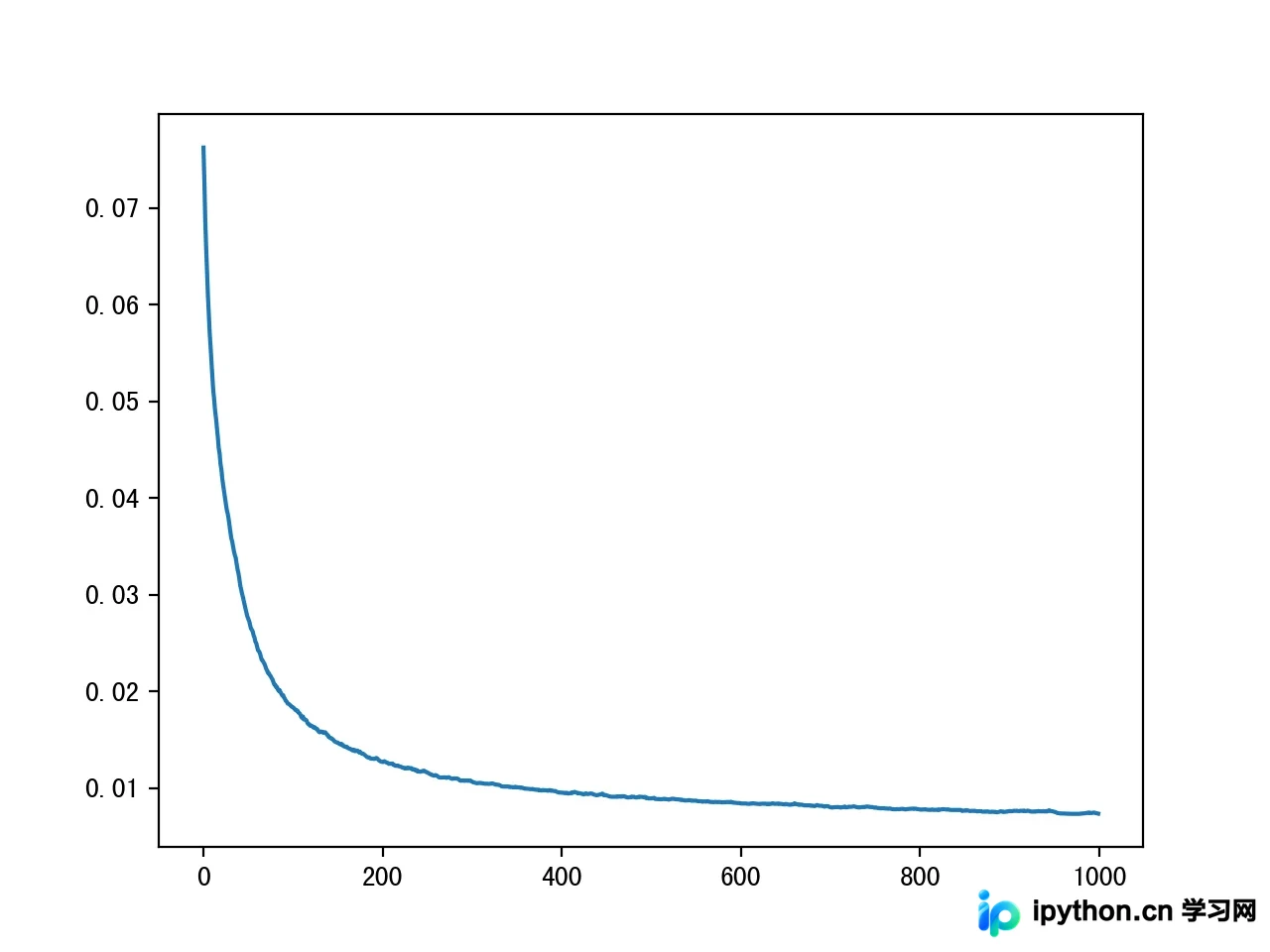
	plt.plot(classifier.L)
	plt.show();

if __name__ == "__main__":
	main();
以下是损失函数在训练过程中的收敛情况展示。
Sun, 29 Sep 2019 18:08:08 softmax.py[line:104] INFO trainning end. predict begin.
Sun, 29 Sep 2019 18:08:08 softmax.py[line:114] INFO right:[7. 2. 1. ... 4. 5. 6.], predict:[7. 2. 1. ... 4. 8. 6.]
Sun, 29 Sep 2019 18:08:08 softmax.py[line:116] INFO The accruacy score is: 0.8486
以上就是本文的全部内容,希望对大家的学习有所帮助,也希望大家多多支持本站。
本站声明
本文内容仅供参考,不代表本站观点。转载或引用请注明出处。如发现内容问题,请通过联系我们页面反馈。















